Ingredients5 min read
What is PHA — and why Pakistani skin needs it.
Glycolic acid built the modern exfoliating toner category. It also built the modern over-exfoliated face. Polyhydroxy acid is the answer to both.
If you have used an exfoliating toner in the last decade, it almost certainly contained glycolic acid. It is the original alpha-hydroxy acid, the smallest and most penetrating molecule in the AHA family, and the workhorse behind almost every "brightening", "smoothing", "renewing" toner on a pharmacy shelf.
Glycolic works. It also stings, sensitises skin to UV, and — used too often — strips the barrier. In a climate where UV exposure is constant nine months of the year, that is a meaningful problem.
Where glycolic falls down
The skin's outer layer renews itself on a cycle. Every cell migrates from the basal layer up to the surface, sheds, and is replaced. Exfoliation accelerates that cycle. AHAs do this by dissolving the desmosomes — the molecular glue holding old cells together at the surface.
Glycolic acid penetrates deep because the molecule is small. That depth is the source of its efficacy and its problems: it works in places it does not need to, irritates more easily, and increases UV photosensitivity for ~24–48 hours after application.
In strong sun, that is the wrong trade-off.
Where PHA picks up
Polyhydroxy acid (PHA) — the main one used in skincare is gluconolactone — is structurally the same family as AHAs, with one critical difference: the molecule is larger. It loosens those same desmosomes at the surface but cannot penetrate as deep. Same exfoliation. No deep irritation. No photosensitisation.
Three things follow from that:
- Daily use becomes possible. A 3% PHA toner can sit in your morning routine without progressively irritating skin. A 10% glycolic cannot.
- Sensitised skin tolerates it. People who flush with lactic or glycolic frequently get on fine with PHA.
- It hydrates as it works. Gluconolactone is also a humectant — it pulls and holds water. Most AHAs are pure exfoliants; PHA does both.
Why this matters where you live
In any climate with high UV index, sustained pollution, and frequent humidity, your skin barrier is under daily stress. The right exfoliation routine has to recognise that. Strong AHAs once a week with extensive recovery can work. Daily gentle exfoliation that does not destabilise the barrier can work. What does not work is daily glycolic followed by sun.
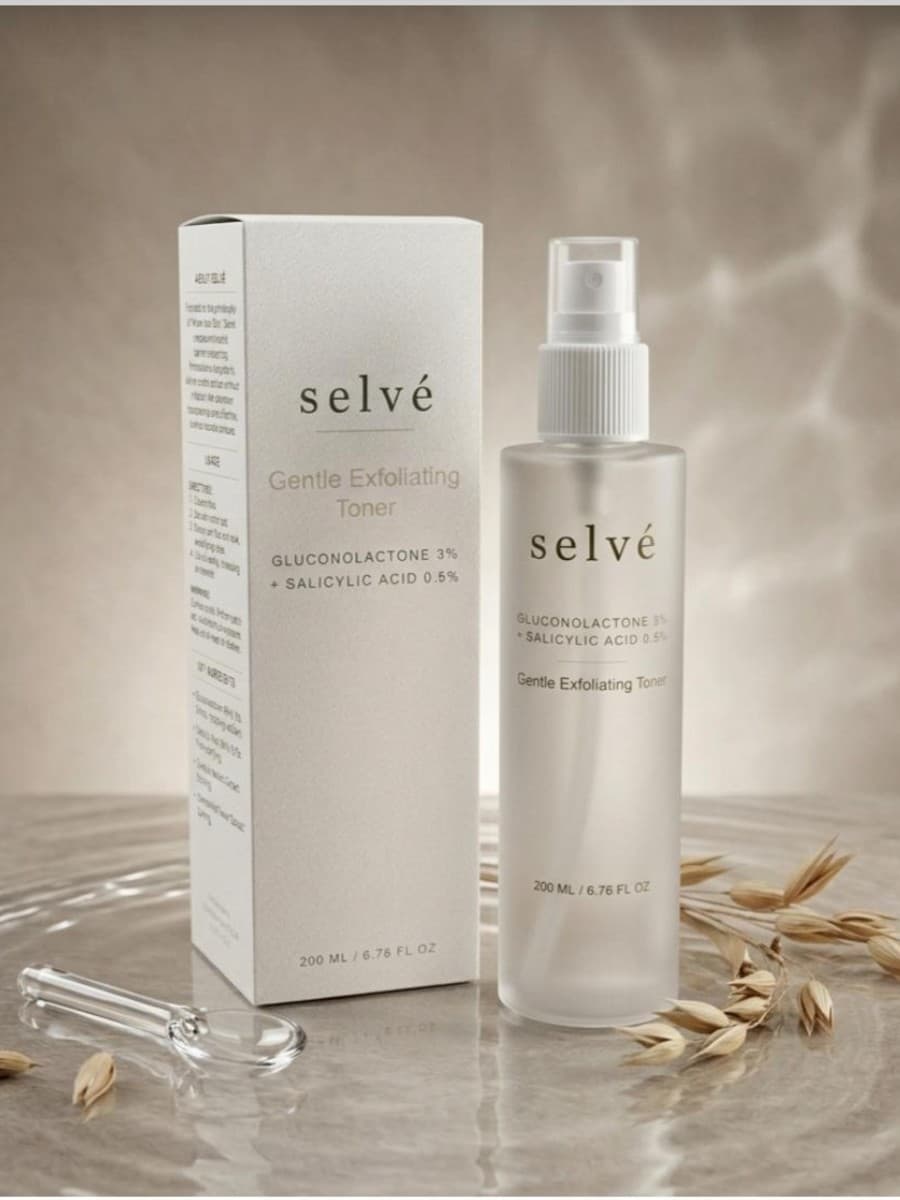
PHA is the answer to the daily-use case. It is why we built the selvé toner around 3% gluconolactone instead of 7% glycolic, paired with 0.5% salicylic acid for pore decongestion and niacinamide for the steady evening of tone.
What to expect
If you are coming from glycolic and switching to PHA, the first two weeks will feel "less". Less tingle, less of the satisfying sting people associate with "the product working". Trust the longer arc. By week 4, texture will be smoother. By week 8, skin will be calmer than it has been on glycolic, with the same evenness — and your barrier will be intact.
That is the trade we wanted to offer.
— selvé